
Most workflow discussions get framed as a feature launch. That undersells the point.
The useful idea is not “Claude can now run more agents.” The useful idea is that some tasks should not live inside one long context window at all.
Dynamic workflows are a better harness for exactly those tasks: work that is long-running, massively parallel, verification-heavy, or easy to derail when one agent has to plan, execute, judge, and summarize everything by itself.
Table of contents
Open Table of contents
The real problem is not raw model intelligence
For ordinary coding work, a single agent in a single context is often enough. But once the task gets bigger, three predictable failure modes show up.
agentic laziness: the agent stops after partial progress and reports a clean finish,self-preferential bias: the agent trusts its own output too easily when it should be judging it,goal drift: the original objective gets blurrier across long runs, compaction, and repeated summarization.
Those are not fringe issues. They appear anywhere the task has many moving parts, vague stopping conditions, or a need for adversarial checking.
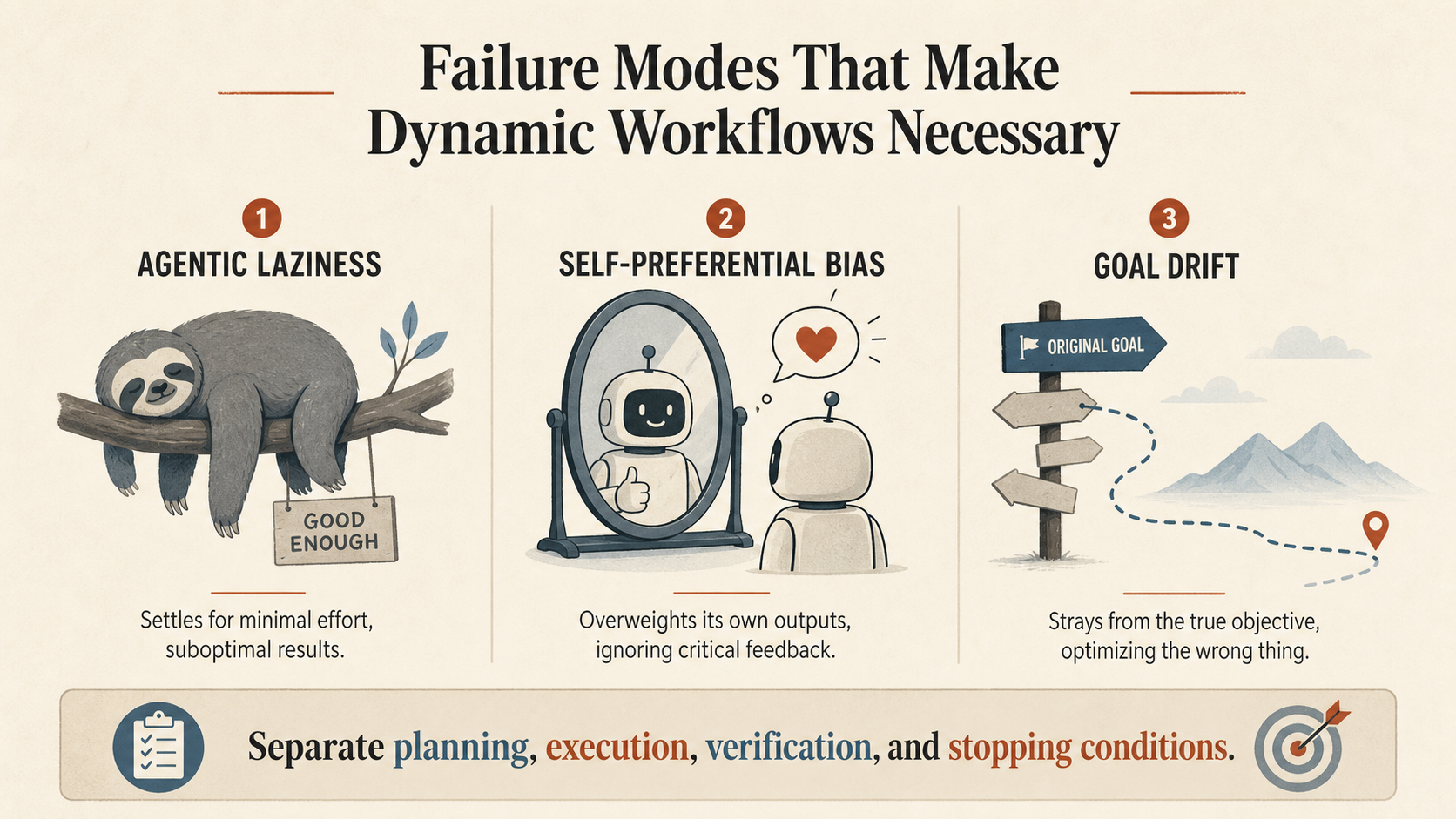
The point of the workflow is structural: separate the roles so one context does not have to do planning, execution, verification, and memory compression all at once.
What dynamic workflows actually change
A normal coding harness asks one agent to hold the whole problem in its head while also deciding what to do next.
A dynamic workflow changes the shape of the work:
- one agent can classify the task,
- several agents can work in parallel on isolated subproblems,
- verifier agents can attack the intermediate outputs,
- and a final synthesizer can merge only the useful results.
That is why the feature is more important than it first sounds. The win is not cosmetic automation. The win is context separation.
In practical terms, dynamic workflows let the harness decide:
- which model to use,
- whether a subagent deserves its own worktree,
- how many parallel branches to spawn,
- what structured outputs each branch must return,
- and what stop condition counts as actually done.
The patterns worth remembering
The source article lists several patterns, but they reduce to one big lesson: do not force every task into a single linear loop.
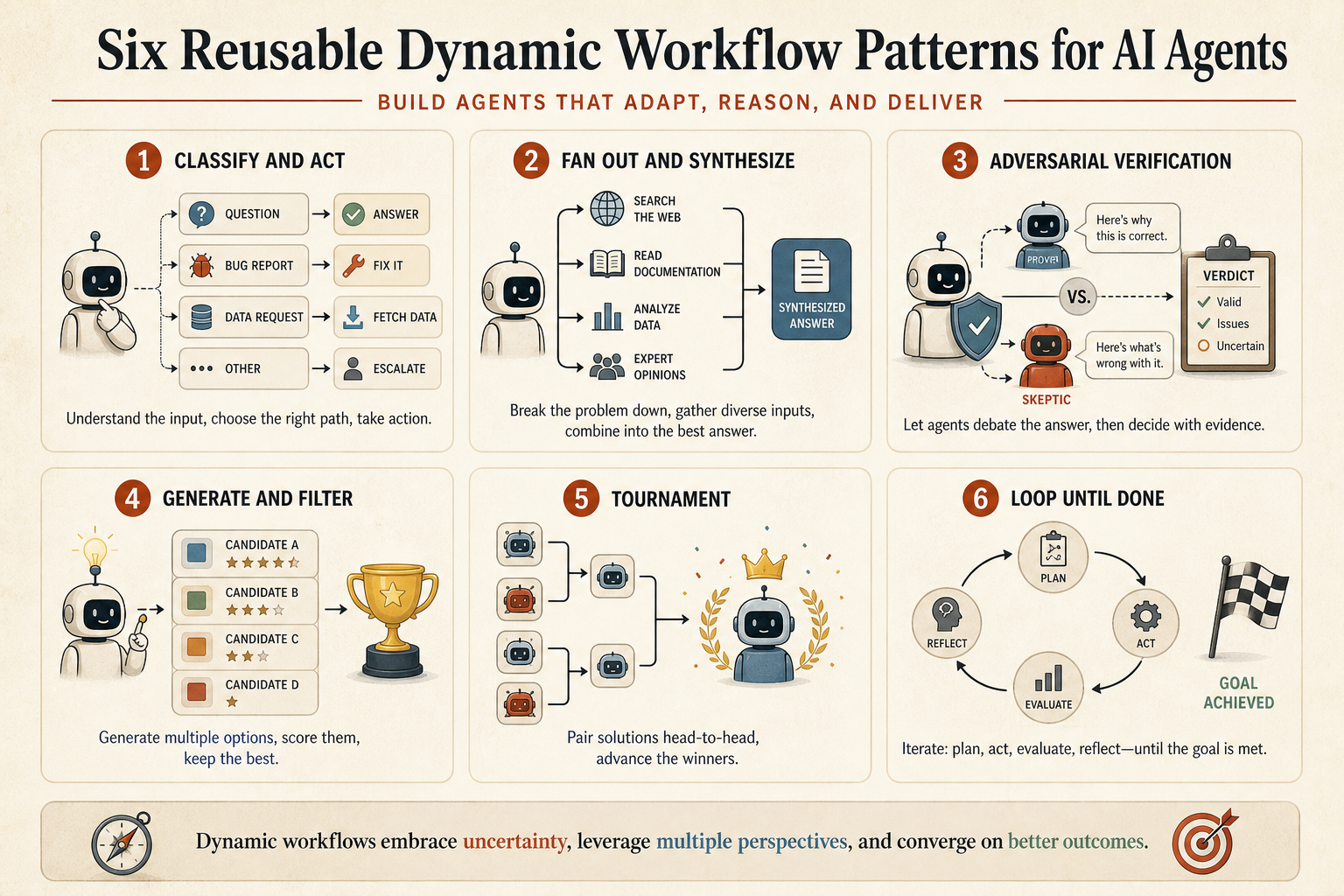
The patterns that matter most in practice are:
Classify and act
Use a small routing step first. Determine what kind of task this is, then choose the right path, toolset, or model.
This is especially useful when the wrong execution mode is expensive. A classifier can decide whether a request is a quick explanation, a code change, a research run, or a high-risk review before the full workflow starts.
Fan out and synthesize
Break a large problem into many local tasks, run them in parallel, then merge them after all branches finish.
This is the pattern behind:
- broad codebase exploration,
- resume ranking,
- multi-issue triage,
- source collection for research,
- and large refactors split by module or callsite.
Adversarial verification
When quality matters, do not let the same agent verify its own answer.
Instead, give the answer to a second agent with a rubric and explicit permission to attack the output. This is the cleanest fix for self-preferential bias, and it is exactly why workflows are promising for evals, security review, and fact-checking.
Generate and filter
For naming, design exploration, plans, or ideas, generation quality improves when many branches propose options and a filter step removes weak or duplicate outputs.
Tournament
Comparative judgment is often stronger than absolute scoring. If you have too many items to rank in one context window, compare them pairwise or bracket them into a tournament.
Loop until done
If the work is open-ended, a fixed number of passes is usually fake certainty.
Instead define a stop condition such as:
- no new findings,
- no failing tests,
- no more untriaged items,
- or no new high-confidence root-cause hypotheses.
Where dynamic workflows pay off first
The best use cases are the ones where the harness needs more structure than a chat loop can comfortably provide.
1. Large migrations and refactors
If a refactor can be broken down by module, callsite, failing test, or file cluster, dynamic workflows are a natural fit. Each branch can work in isolation, and a review branch can verify the change before merge.
2. Research and deep verification
Research is not just “search the web.” Good research usually means collecting many sources, checking them against each other, and refusing weak evidence. That is almost a textbook case for fan-out plus verification.
The reverse direction is just as important: if you already have a report or draft, use a workflow to extract claims and verify each one independently.
3. Evals and rubric-based judging
This is one of the strongest applications for agent builders.
If you are evaluating prompts, skills, or agent behaviors, a dynamic workflow can:
- run multiple candidates,
- score them against a rubric,
- adversarially verify the scoring,
- and synthesize the final judgment.
That is much closer to a real evaluation harness than asking one agent for a vibes-based verdict.
4. Rule mining and memory cleanup
One of the most practical examples in the source article is mining past sessions for repeated corrections and turning them into durable rules.
That works because the task has a clean workflow shape:
- gather candidate corrections,
- cluster them,
- verify that each one would have prevented a real mistake,
- and keep only the rules that survive scrutiny.
5. Root-cause investigation
Debugging improves when hypotheses are generated independently from different evidence pools. One branch looks at logs, another at code, another at data, and separate branches refute each hypothesis.
That structure makes it harder for one early guess to dominate the whole investigation.
The trap: not every task deserves this much machinery
Dynamic workflows are easy to overuse.
They cost more tokens, add orchestration overhead, and can become theater if the task is small enough for a normal agent to handle cleanly.
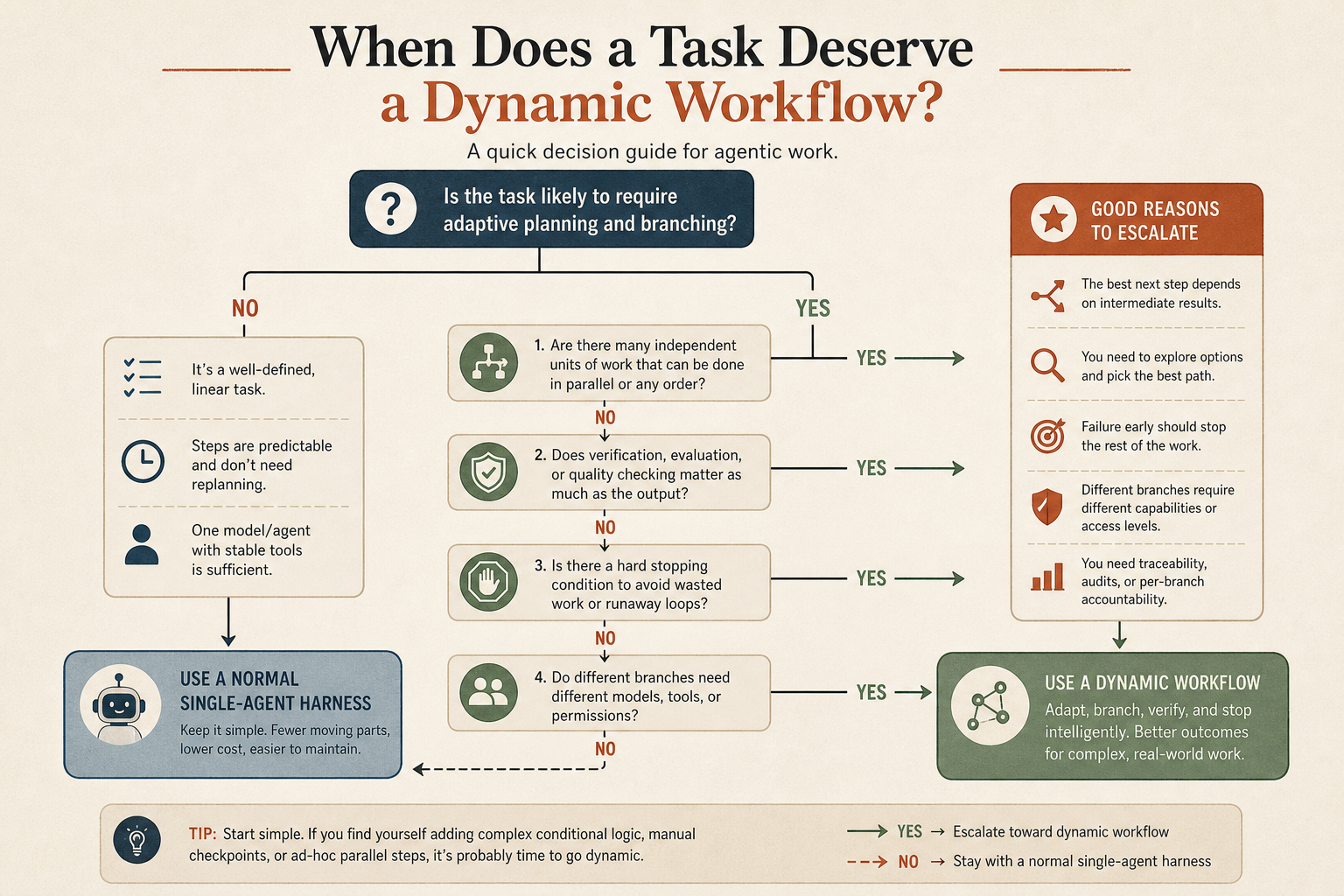
The practical question is not “Can I parallelize this?” It is “Will context separation materially improve the result?”
Usually the answer is yes only when at least one of these is true:
- the task contains many independent units of work,
- verification quality matters as much as generation quality,
- the stopping condition is hard to enforce in one context,
- different parts of the task benefit from different models or permissions,
- or the agent has a real risk of drifting, stopping early, or grading itself too kindly.
If none of that is true, a plain harness is probably the better tool.
A good mental model for using them
The most useful way to think about dynamic workflows is not “multi-agent by default.”
It is this:
- keep the main objective explicit,
- isolate branches that would contaminate each other,
- make outputs structured enough to compare,
- separate generation from judgment,
- and define a real stop condition.
That is what turns workflows from an expensive trick into an actual reliability tool.
The real takeaway
Dynamic workflows matter because they let the harness match the shape of the task.
That is the shift.
Instead of asking one context window to do everything, you can decompose the work into roles: router, worker, verifier, judge, synthesizer, loop controller. Once you do that, many tasks that used to feel fragile start looking more like systems problems than prompt problems.
For agent builders, that is the important update. The future win is not just smarter models. It is smarter harnesses that know when one agent is enough and when the work needs structure.
Based on Thariq Shihipar’s June 2, 2026 post on dynamic workflows in Claude Code, this rewrite focuses on the operational idea that matters most in practice: use workflows when the task needs context separation, not just more compute.